

If you’ve ever wondered how to market a mission-driven brand without falling into the trap of sounding performative or vague, the answer isn’t as simple as “talk about your mission more."
The purpose-driven brands that succeed aren’t the ones with the most inspiring mission statement. They’re the ones that translate purpose into resonance: clear positioning, consistent messaging, evidence-backed storytelling, and a strategy that turns values into action. In this article, we’ll break down why some purpose-led brands struggle to grow, how mission-driven companies can compete with profit-driven giants, and what it means to leverage your mission as your competitive edge.
Why do some purpose-driven brands struggle to grow?
The reality is that some purpose-driven brands miss opportunities to leverage their mission as a strength in marketing communication. One of the most common challenges in purpose-driven marketing strategy is balancing visibility with integrity. The necessary balancing act of growing visibility in the competitive marketplace, while remaining true to mission and values can be paralyzing to the values-driven marketer. The first step to overcoming common pitfalls for mission-driven brands is to identify them, which is exactly where we’ll start in this section.
When purpose-driven marketing backfires
A brand’s underlying mission can become a liability when it’s communicated vaguely or unstrategically. There are many reasons why this pitfall may arise, but something we often see with mission-driven brands is a tendency to tread lightly in marketing communications, presumably in an effort to avoid coming across as too bold or controversial. While this approach will most certainly protect brands from criticism, it can also keep them from saying much beyond redundant sentiments that uncontroversially align with their purpose. This puts them at risk of blending into the cacophony of competing voices. As renowned marketer Seth Godin put it:
“In a busy marketplace, not standing out is the same as being invisible.”(1)
There’s reputation management, then there’s overly-safe messaging lacking in substance. The two don’t have to go hand in hand. This doesn’t mean using controversy as an attention-grabbing scheme, it means being unafraid of authentically communicating your purpose in ways that capture interest. Expect some pushback, engage in those more nuanced conversations, and the audience you’re actually trying to communicate with will resonate.
The credibility gap: saying it vs. proving it
Some purpose-driven brands have a clear mission, and they communicate it well. The problem is that many stop there. This is where many brands unintentionally drift into performative marketing—not because the mission isn’t real, but because the communication lacks proof.
For example, imagine a company selling plastic-free, reusable food storage containers. Their mission is simple: reduce reliance on single-use plastics and cut down on plastic pollution. They might communicate that mission like this:
“Our reusable food storage solutions will eliminate the need for single-use plastics in your kitchen. Join us in our mission to halt plastic pollution.”
Now compare it to a message that’s more grounded in context:
“Plastic bags make up approximately 12% of global plastic pollution. Let’s make it 0%." (2)
Which feels more credible? Both statements point to the same mission, but the second adds some weight: it gives the audience a sense of scale, consequence, and shared responsibility. It transforms the brand’s purpose from a claim into something that feels measurable, real, and worth acting on.
The takeaway is simple: purpose becomes persuasive when it’s supported by proof. If your brand stands for something, don’t just declare it—show people why it matters and highlight the cause they’re supporting when they choose you.
How do mission-driven brands compete with larger, profit-driven brands?
Mission-driven brands can position themselves to compete with profit-driven monoliths by adapting the use of proven, effective marketing tactics for a values-aligned marketing strategy. With the unique set of challenges that mission-driven brands face by nature of their commitment to certain values, there also exists a unique array of strengths which can be leveraged to communicate a compelling competitive edge.
Purpose as a through line, not just a tagline
Purpose becomes a competitive advantage when it lends itself to consistency across the brand—visual identity, online presence, community action, product lines or services—every touchpoint. Many mission-driven brands leverage their mission primarily as a headline or tagline, something to tack onto a homepage or assert in an Instagram bio.
When your purpose is fully integrated, it informs every decision made from the realm of product decisions to partnerships, from tone of voice to visuals. That consistency fosters consumer trust and community action that is more deeply-rooted than a limitless marketing budget.
Dr. Bronner’s: A Case Study
If you’ve ever had the experience of rinsing in the shower and reading through the aphorisms preaching hope, love, and unity filling the space of your soap bottle’s colorful label, you’ve likely encountered Dr. Bronner’s natural soaps. Beyond their packaging, Dr. Bronner’s mission to promote a message of peace and unity is reflected in every aspect of the company—from customer and employee experience to fair-trade practices and social justice advocacy (3).

The company does not shy away from projecting their message and uncompromising adherence to principle in marketing channels and campaigns. In one Instagram post sharing the company’s All-One! Report for 2025, CEO David Bronner boldly calls out the CEO-to-Worker ratio at S&P 500 companies sitting at a whopping 344:1 compared to Dr. Bronner’s 5:1 (4). This is nothing out of the ordinary for Dr. Bronner’s—the company has remained consistent in its bold, mission-led marketing strategy.
This consistent commitment to mission and values has cultivated a strong base of consumer loyalty, which has allowed the company to compete with market leaders in the natural soaps category. In 2024, the company reported a whopping $209 million in net revenue (5). The consistency of mission-adherence across company action and marketing touchpoints allows conscious consumers feel as though they can actually trust Dr. Bronner’s to operate in accordance with their communicated values, and reward the company with their buying decisions.
Purpose-driven marketing strategy: Why purpose doesn’t replace strategy
Hopefully it’s becoming clear that the purpose driving your business/organization is not a replacement for marketing strategy, it’s an amplifier. This perspective shift allows mission-motivated marketers to use proven marketing tactics in a way that aligns with their values—it just requires an added degree of intentionality.
What effective purpose-driven marketing actually requires
Effective marketing for mission-driven brands requires additional clarity and intentionality across a few key aspects of marketing strategy. This means looking at the following areas with a critical eye to assess how and if each pillar of your marketing strategy is doing what it needs to do, in the right way:
- Crystal-clear positioning: Adopt a position that rejects ambiguity in favor of taking a clear stand
- Audience understanding: Get to know those who already care about your mission, as well as those on the edge of caring
- Channel intentionality: You don’t have to show up everywhere, show up where it counts
- Consistent, aligned execution: Engage with your audience in capacities that provide value and flow seamlessly from your underpinning purpose
- Metrics that go beyond vanity: Beyond clicks and follower growth, find ways to measure impact, brand trust, and loyalty
Purpose as a filter: A purpose-driven marketing strategy framework
Marketing strategy is the who, where, what, and how that informs the channels you invest in, messaging tone, audience targeting, visual graphics, etc.—none of that changes. Your mission, purpose, and values are a filter through which decisions funnel to keep the strategy aligned with your vision.
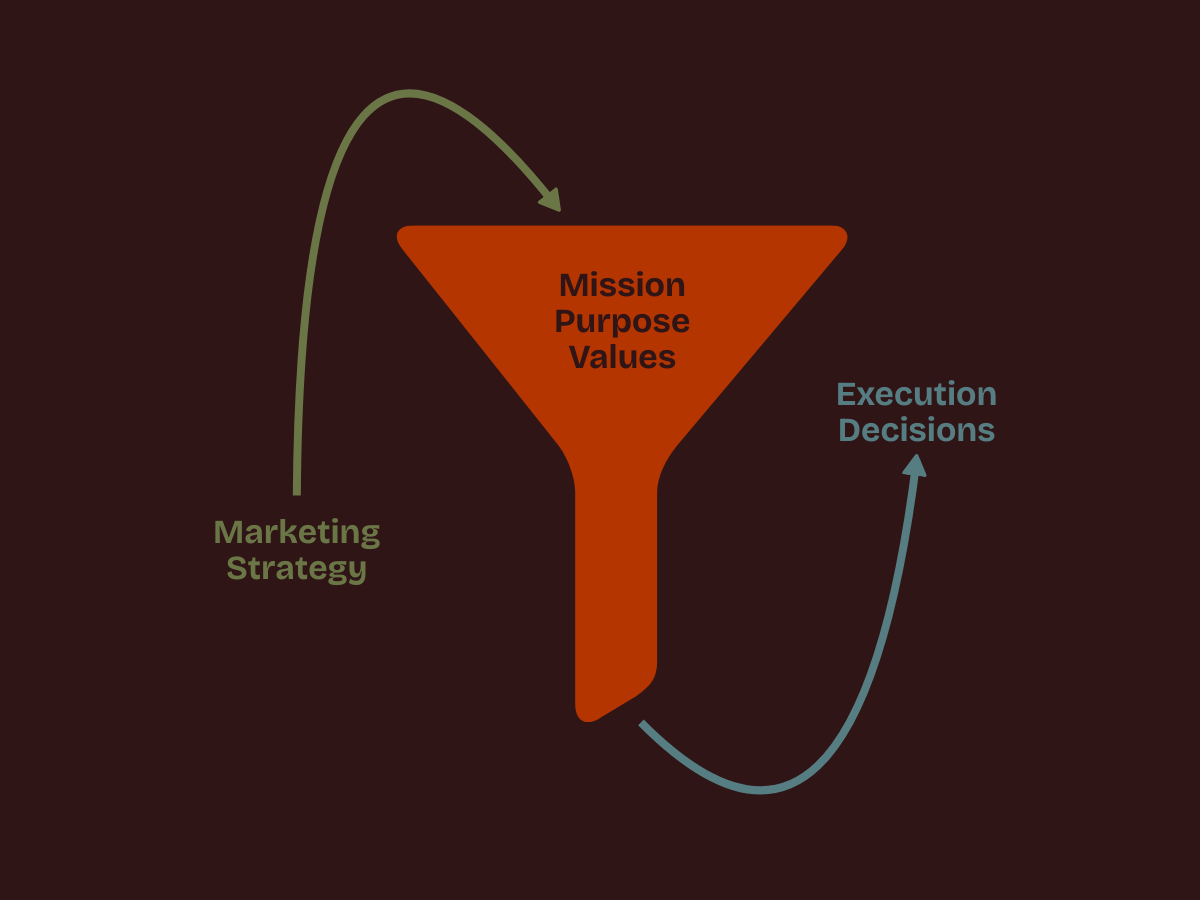
Consider the filter questions that a chocolate brand driven by their mission to promote fair trade and ethical manufacturing practices might run through when making strategic marketing decisions:
- Does this reinforce or distract from our mission to promote fair trade & ethical manufacturing?
- Does the visual style and tone feel aligned with a grounded, human-centered story?
- Would our suppliers/farmers feel respected by how we’re telling this story?
- Are we making claims we can prove? (with certifications, traceability, or reporting)
- Are we choosing partners/influencers who align with our values?
Filtering final decisions about marketing campaigns and activations through a set list of questions is a simple and actionable step that ensures all marketing touchpoints are aligned with your mission. This feeds into the consistency that earns trust and buy-in from your audience (6).
When mission becomes a multiplier
Far from being a liability, a brand’s mission can be a multiplier when purpose is communicated with clarity, narrative, evidence, and consistency. It doesn’t slow growth, it compounds it in the desired direction: attracting the right customers, inspiring deeper loyalty, and creating brand trust that can’t be bought with ad spend alone.
When your mission is treated as a strategic foundation rather than a standalone tagline, it strengthens everything built on top of it. Messaging becomes more credible. Differentiation becomes easier. Trust is earned. Instead of competing purely on price, convenience, or trend cycles, mission-driven brands compete on consumer advocacy and a proven reputation for enacting positive change.
FAQ
Not inherently. Purpose only slows growth when it’s treated as a constraint rather than a strategy. In reality, a clear mission can accelerate growth by building trust, loyalty, and differentiation—especially in crowded markets where many brands feel interchangeable. The key is making sure purpose is communicated with specificity and proof, not vague values language.
Purpose becomes a growth advantage when it strengthens positioning, attracts the right audience, and creates consistency across the brand. The brands that struggle aren’t the ones with a mission—they’re the ones that rely on mission alone without a clear marketing strategy behind it.
Sustainable brands rarely win by trying to outspend bigger competitors. They win by out-positioning them. When purpose is embedded into the product, messaging, and customer experience, it creates a level of trust and credibility that larger brands can’t easily replicate—especially when sustainability is only a surface-level initiative for them.
The competitive advantage comes from clarity: clear differentiation, consistent storytelling, proof-backed claims, and a recognizable brand identity.
A few strong examples of expert-level, purpose-driven marketing include Dr. Bronner’s, which integrates its social mission into everything from packaging to activism and public reporting. Tony’s Chocolonely is another standout, building its entire brand around ethical sourcing and anti-slavery advocacy in the chocolate industry. Patagonia remains a classic example of environmental mission translated into real action through supply chain transparency, activism, and community investment.
What these brands have in common is that their purpose isn’t just a tagline, it’s a through line. Their marketing works because it’s reinforced by real business decisions, consistency across channels, and an uncompromising approach to upholding their values.
References
- Seth Godin: Purple Cow: New Edition — Transform Your Business by Being Remarkable (Quote: “In a busy marketplace, not standing out is the same as being invisible.”)
- Repurpose Global: “Major Contributors to Plastic Pollution” https://www.repurpose.global/blog/major-contributors-to-plastic-pollution
- GQ: "Is Dr. Bronner’s the Last Corporation With a Soul?" https://www.gq.com/story/dr-bronners-corporate-success
- Dr. Bronner’s (Instagram): “All-One! Report 2025” (Post by David Bronner) https://www.instagram.com/p/DOEhFbdj7U2/
- Dr. Bronner’s: “All-One! Report 2025” https://www.drbronner.com/pages/all-one-report-2025?srsltid=AfmBOoqAVfSRYVNvsDWRh0Wtazmg4SScCeLA_4-dQLiXjaPAC4EKjJfm
- Forbes Communications Council: “The Importance of Consistency in Branding” https://www.forbes.com/councils/forbescommunicationscouncil/2024/12/30/the-importance-of-consistency-in-branding/
.png)